

Finance Media Analysis: EU AI Act Sets Global Compliance Benchmark but Risks Widening Europe's AI Investment Gap

Finance Media, a B2B digital media and intelligence company
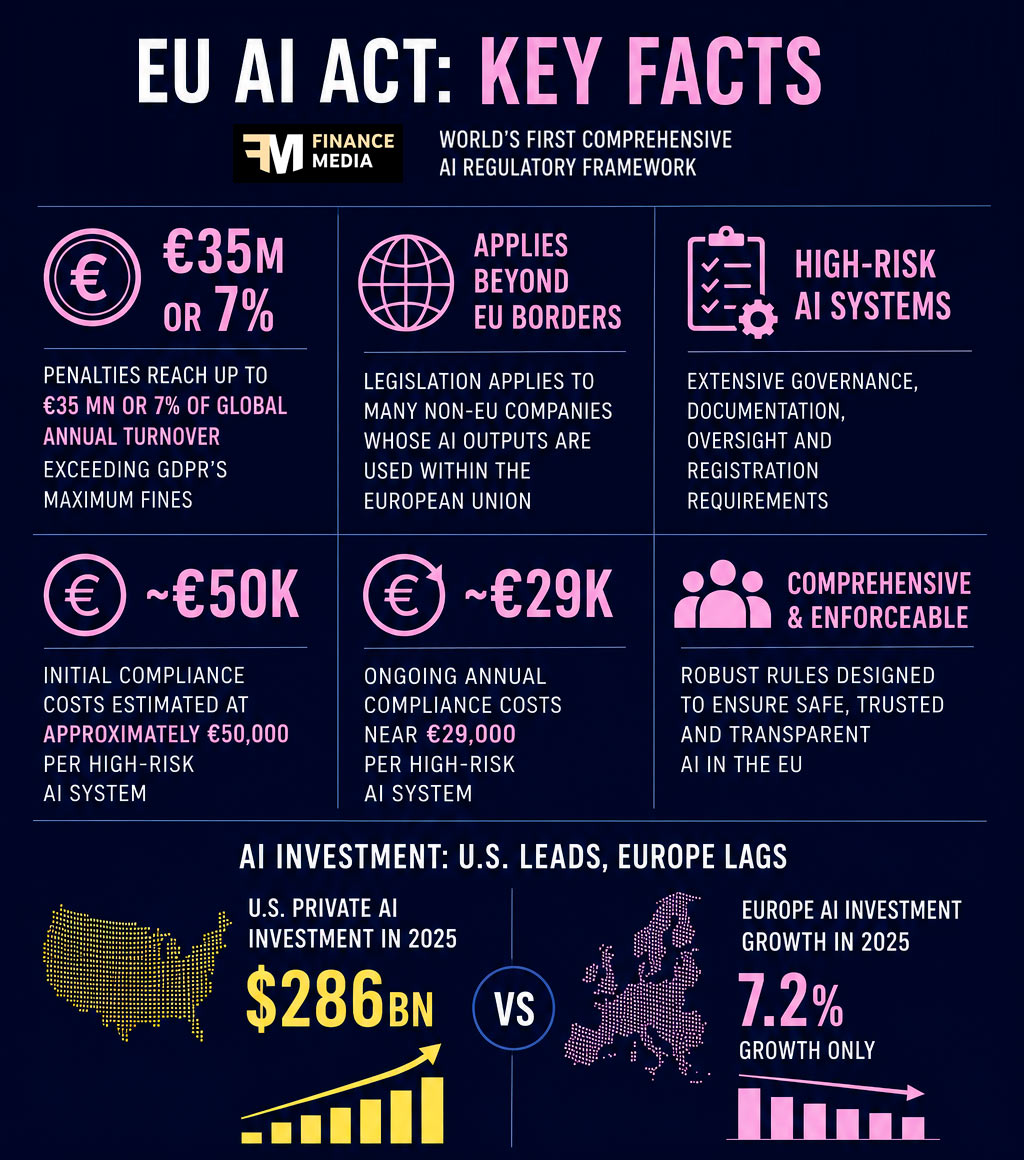
EU AI Act: Key Facts and Investment Gap
Finance Media analysis finds the world's toughest AI regulation extends beyond EU borders as businesses face compliance costs and competition for AI leadership
Europe continues strengthening AI governance while facing increasing competitive pressure from significantly higher investment levels in the U.S. High-risk AI systems face extensive requirements”
NEW YORK, NY, UNITED STATES, July 29, 2026 /EINPresswire.com/ -- Finance Media, a B2B digital media and intelligence company covering insurance, artificial intelligence, InsurTech, cybersecurity and financial markets, released a new analysis examining the business implications of the European Union's Artificial Intelligence Act, concluding that the legislation establishes the world's most comprehensive AI regulatory framework while exposing a widening gap between Europe's regulatory ambitions and its global competitiveness.— Oleg Parashchak, CEO and founder of Finance Media and Beinsure
The EU AI Act introduces a risk-based framework governing artificial intelligence across virtually every sector of the economy. The legislation also carries some of the toughest financial penalties ever imposed under technology regulation, allowing fines of up to €35 mn or 7% of a company's global annual turnover for the most serious violations, exceeding the maximum penalties available under the General Data Protection Regulation (GDPR).
Unlike many regional regulations, the AI Act reaches well beyond the European Union. Any company whose AI systems generate outputs used by individuals within the EU may fall within its scope regardless of where the developer, software provider or insurer is headquartered.
"The EU AI Act establishes a global compliance benchmark rather than simply another European regulation," said Oleg Parashchak, CEO and Founder of Finance Media and Beinsure. "Its extraterritorial reach means AI developers, insurers, financial institutions and technology companies worldwide must evaluate whether their governance, documentation and risk-management processes satisfy European requirements."
A RISK-BASED FRAMEWORK THAT REACHES ACROSS INDUSTRIES
The AI Act introduces a comprehensive classification system that places AI applications into different regulatory categories according to the level of risk they present.
High-risk AI systems, including recruitment software, credit-scoring platforms, medical diagnostic solutions, educational technologies and AI supporting critical infrastructure, must comply with extensive governance obligations before entering the European market.
Developers and deployers are expected to implement formal risk-management systems, maintain detailed technical documentation, provide meaningful human oversight, complete conformity assessments and register qualifying systems within the European Union.
The legislation also prohibits several categories of AI entirely, including social scoring, workplace emotion-recognition systems and the mass scraping of facial images for biometric databases. AI-generated content, deepfakes and AI-driven interactions must include transparency notices informing users when content has been generated or significantly modified by artificial intelligence.
COMPLIANCE CARRIES SIGNIFICANT FINANCIAL COSTS
Finance Media's analysis shows that regulatory compliance represents become a material business expense.
Industry estimates suggest bringing a single high-risk AI system into compliance requires an initial investment of approximately €50,000, followed by annual compliance costs of roughly €29,000 to maintain documentation, governance, monitoring and reporting obligations.
These expenses arrive at a time when many AI developers continue investing heavily in computing infrastructure, foundation models, cybersecurity and product development, creating additional pressure on operating margins for startups and growth-stage technology companies.
"The largest competitive challenge is not the size of the penalties," Oleg Parashchak said. "It is the cumulative cost of compliance. Every euro devoted to documentation, governance and regulatory reporting is capital that cannot be invested in engineering talent, compute capacity or product innovation. Successful regulation must protect consumers without reducing the ability of European companies to compete globally."
~~~~~~~~~
KEY FINDINGS
• The EU AI Act establishes the world's first comprehensive AI regulatory framework.
• Penalties reach up to €35 mn or 7% of global annual turnover, exceeding GDPR's maximum fines.
• The legislation applies to many non-EU companies whose AI outputs are used within the European Union.
• High-risk AI systems face extensive governance, documentation, oversight and registration requirements.
• Initial compliance costs are estimated at approximately €50,000 per high-risk AI system, with ongoing annual costs near €29,000.
• U.S. private AI investment reached $286 bn in 2025, compared with just 7.2% investment growth across Europe, according to Beinsure report.
• Europe continues strengthening AI governance while facing increasing competitive pressure from significantly higher investment levels in the United States.
~~~~~~~~~
REGULATION ADVANCES WHILE INVESTMENT FALLS BEHIND
Finance Media's analysis identifies a growing divergence between Europe's regulatory leadership and global AI investment trends.
According to Stanford's AI Index 2026, private AI investment in the United States reached $285.9 bn in 2025, representing 160% year-over-year growth.
Europe, by comparison, recorded investment growth of just 7.2% during the same period.
The gap becomes even more pronounced in generative AI, where U.S. companies attracted $163.6 bn in investment, while Europe and China combined secured only $4.7 bn.
Mario Draghi's competitiveness report further estimates that roughly 30% of European AI unicorns have relocated to the United States, reflecting continued migration toward larger capital markets, stronger computing infrastructure and broader commercial opportunities.
THREE GLOBAL AI MODELS CONTINUE TO DIVERGE
Finance Media's analysis concludes that the world's three largest AI ecosystems are following increasingly different strategic paths.
The United States continues emphasizing private investment, rapid commercialization and judicial enforcement after disputes arise.
China combines targeted regulation with substantial government funding while continuing to narrow the frontier-model performance gap with U.S. developers.
Europe has prioritized comprehensive regulation before establishing AI companies capable of competing globally at comparable scale. This divergence increasingly influences investment decisions, startup formation, talent migration and long-term competitiveness. See how AI, geopolitics and regulation are redefine corporate risk - https://beinsure.com/ai-geopolitics-regulation-redefine-corporate-risk/
"Rules alone have never produced global technology leaders," Oleg Parashchak said. "Leadership requires capital, computing infrastructure, engineering talent, access to high-quality data and markets large enough to scale innovation. Regulation works best when it supports those foundations rather than attempting to replace them."
IMPLICATIONS FOR THE INSURANCE INDUSTRY
The AI Act introduces additional complexity for insurers adopting artificial intelligence across underwriting, pricing, fraud detection, customer service and claims operations. See how the EU AI Act will affect the insurance industry - https://beinsure.com/eu-ai-act-affect-insurance/
Insurance applications that combine multiple functions or rely on biometric information may fall within higher-risk regulatory categories, triggering additional governance obligations.
Most insurers are expected to rely on external large language models supplied by technology providers, making vendor selection, contractual oversight and AI governance increasingly important components of enterprise risk management.
The regulation also overlaps with existing frameworks including Solvency II, DORA and GDPR, creating a more complex compliance environment for multinational insurers operating across multiple jurisdictions. See what drives the accelerated AI adoption in the insurance industry - https://beinsure.com/ai-adoption-in-insurance/
Finance Media believes insurers should establish multidisciplinary AI governance teams bringing together specialists from underwriting, compliance, legal, cybersecurity, data science and technology functions. Organizations must also strengthen technical expertise, monitor emerging AI security threats and prepare for future standards such as ISO 42001 governing AI management systems.
OUTLOOK
The EU AI Act will likely become one of the most influential technology regulations adopted during the coming decade. Its extraterritorial scope ensures that businesses serving European customers will increasingly align governance practices with EU standards regardless of where products are developed.
However, Finance Media concludes that regulatory leadership alone will not determine global AI competitiveness.
Europe's long-term position will depend on whether regulation is accompanied by sustained investment in computing infrastructure, venture capital, technical talent, research capacity and commercial AI ecosystems capable of competing with the United States and China. See why most AI startups fail to deliver ROI - https://beinsure.com/ai-projects-deliver-roi/
Without parallel investment, compliance risks becoming an additional competitive cost rather than a strategic advantage for European technology companies.
About Finance Media
Finance Media, a European media and digital intelligence group working at the intersection of finance, insurance and technology, provides market intelligence and analysis covering insurance, reinsurance, artificial intelligence, cybersecurity, InsurTech and financial markets. Its research examines underwriting trends, emerging regulation, digital transformation, cyber risk, AI governance and technology adoption across global financial services. The company, founded on 6 March 2008, operate, invest in and develop specialist digital insurance platforms such as Beinsure.com and Forinsurer.com, creating high-value content, market insight and analytical solutions for professionals across the insurance, insurtech, fintech and banking sectors.
Tetiana Mykhailova
Finance Media
email us here
Legal Disclaimer:
EIN Presswire provides this news content "as is" without warranty of any kind. We do not accept any responsibility or liability for the accuracy, content, images, videos, licenses, completeness, legality, or reliability of the information contained in this article. If you have any complaints or copyright issues related to this article, kindly contact the author above.
